By Ben Ogden
Good evening America, I am here tonight to inform you that I am running for president of the United States under the Republican Party. I plan to follow many of the current projects and policies made by the current Bush administration. I know that the current administration is not extremely well liked, but our nation needs a new president who will continue what the Bush Administration has proposed.
Our nation went to war in Iraq to destroy Saddam’s weapons of mass destruction, yet none were found. However, intervention was needed in the area due to the terrorist cells that continue to be found. I propose to continue our war in Iraq until we are successful. A clear definition of success has yet to be determined. However, not only must we continue our war in Iraq, but we must continue our search for terrorists in Afghanistan. We have had troops deployed in that nation since shortly after the September 11th tragedy, and they will continue to be deployed there until we have assured that any terrorists who want to do harm against the United States have been detained and if necessary, killed. Also nations like Iran and North Korea, nations the U.S. believes have the capability of producing nuclear weapons, need to be addressed. For the past year or so we have attempted to speak to the North Koreans about the termination of there nuclear weapons program, unfortunately they have not complied. We need to assure that these nations will discontinue their nuclear developments. If they do not comply we will use some sort of pressure to ensure that they do as asked. Terrorism against the United States is unacceptable and will not be tolerated by my administration.
Another important issue is that of illegal immigration. At this time there are far too many illegal immigrants entering the United States. We need to develop better border protection, especially along our southern border with the nation of Mexico. This should be done by continuing the project to build a massive wall, continuing to leave National Guardsmen on duty along the border and hiring of private companies to assist the Nation Guardsmen to protect the border. We should allow immigrants into the nation, and allow them to work and receive education, but we must limit our intake. We need these immigrants to work for us to ensure that jobs that Americans do not want to do are fulfilled. These workers should be give permission to work and sent home after a set length of time as to allow all immigrants to work in our fine country.
The new energy program announced by President Bush, although very vague is an important aspect. Although some people, including myself, do not agree that global warming exists we still need to find cheaper forms of energy. Another important program is the health care program for self employed Americans. I like President Bush’s idea and will continue to work based on what he has already put forth.
As I said at the beginning of this announcement I plan on following as much as President Bush’s policy as possible. The ideas I just brought forth are my main plans for our nation under my administration, if elected. I would just like to thank those of you who plan on supporting me. Thank you and goodnight.
February 08, 2007


February 07, 2007
Vote for Me in 2008: Kristina Longhitano
As many other candidates prepare to announce their plans to run for the presidency in 2008, I feel that I will be the one candidate that stands out amongst the fray. Like Martin Luther King Jr. said once before, “I have a dream,” I too have a dream to try and fix the many problems that we have in this great country of ours.
Some of the ideas and issues that I truly care about and want to fix are the institution of universal health care and universal education, including providing college to graduating high school seniors. I care about fixing environmental issues, curbing global warming, and establishing Fair trade. I will work towards repairing the problematic exportation of U.S. jobs and the difficulty of the U.S. becoming a service economy.
I grew up in a middle class family in New York State, I feel I’ve had a good life and I would like to extend this to everyone in the country. Nowadays, it seems like the lower class and middle class has been forgotten about by the elites, and I intend to change this.
For the last six years George W. Bush has led our country in the wrong direction, but if I’m elected president I will steer our course back on track and restore the integrity of America to the world. I will accomplish these goals by listening to the views of the American people, if they truly feel that something is wrong then we will fix that problem, and not ignore your wishes. In the real U.S., we have a melting pot, not just of cultures but beliefs as well and my issues appeal to everyone whether you are Democrat, Republican, or Independent because these are humanistic values that we all share.
By Kristina Longhitano
February 06, 2007
Speech to the Nation: An International Approach

By Kristina Longhitano
Thank you Mr. President, I appreciate you giving me the opportunity to speak to my country. I do enjoy the rights afforded to me in this great country, the most important being the freedom of speech.
Though, in these times it will suffice to say that freedom of speech has been greatly limited because of the fear of terrorism. The United State’s international policy in my mind has become warped. The War in Iraq has become the main focus of our attention. Too much focus is put on fighting an enemy that we are blind to. Instead, we should focus our foreign policy on humanitarian aid. Right now the situation in Iraq is dismal at best. There is no end in sight, Iraq has become this generations’ Vietnam. My proposal is to redirect our international policy back to its original intentions, where we helped countries in need.
A horror that is occurring as we speak is the dire situation in Darfur, Sudan. It has been called genocide by many people, but yet we have done nothing to truly stop these atrocities.
Why are countries like Iraq more important than places like Sudan? It is because of profit and location. Instead of truly trying to help people, this country is focused on publicity. The government has convinced Americans that is is justifiable to fight in the Middle East against terrorism. Yet, the American government has nothing to try to justify fighting for peace in Sudan.
We cannot become protectionists and close ourselves off from the world. We established a precedent with World War I that we have to uphold. Previously, our policy was to help those in need. Now our aid policy is much more politically selective. Instead of this, the USA needs to fully support the UN, and help all those in need. Furthermore we have to examine each situation more closely than we have in the past and look at our mistakes in order to fix the problems instead of making them worse. We need to learn from our mistakes, not repeat them.
Speech to the Nation: Support Our Troops!

By Ben Ogden
Thank you Mr. President. Good evening America. As you all know, America has been involved in a war against terrorism for the past four years. We currently have troops deployed in Afghanistan and Iraq who are fighting for safety and security for our nation, and the rest of the world. I, as with most of this government’s administration, know that many Americans do not agree with the war in Iraq at this time. However, when we began the war there was a strong support from our nation as a whole. I am not here to preach to you that it is your job as the American public to support the war. You, the people, have a right to be against this war.
I am here, though, to ask you to regain the levels of patriotism we had after the attacks on September 11. After these horrendous terrorist attacks on the World Trade Center and the Pentagon, the American public had a revived level of patriotism that remained strong, even when we first deployed troops to the Middle East. But, with the increasing disapproval of the war, there has been a decrease in support for our troops and a decrease in patriotism. You may not agree with the war, but our fellow Americans are in Iraq fighting, and loosing their lives, to help make America and the rest of the world a safer place. They deserve every ounce of our support.
We need to support and pray for our troops. And, next time you see someone who serves in any branch of the U.S. military, thank them for what they do for your country. They deserve it. Once again, I would just like to state that the United States needs a strong increase in patriotism and support of our troops, even if you do not agree with the war. We should be proud to be Americans and we should show this.
Thank you America, and Goodnight.
January 30, 2007
Addressing the State of the Bush Administration
 A Response and Critique of the 2007 State of the Union Address
By Courtney Shannon
“Mr. President, a prayer for your success,” mentioned someone from the crowd. I’m sure the gentleman who said this was not the only one who was praying for President George W. Bush’s speech to go well.
At approximately 9:10 pm EST President George Bush began his opening remarks of his State of the Union Address by welcoming Nancy Pelosi as the first “Madame Speaker,” and congratulating the Democratic Congress on their success.” He mentions, “Congress has changed, but not our responsibilities. Each of us is guided by our own convictions -- and to these we must stay faithful. Yet we're all held to the same standards, and called to serve the same good purposes: To extend this nation's prosperity; to spend the people's money wisely; to solve problems, not leave them to future generations; to guard America against all evil; and to keep faith with those we have sent forth to defend us.”
Following his outlining statement, Mr. Bush spent just two minutes per topic, discussing the economy, health care and social security, education, immigration, and energy. He then devoted twenty minutes, ten times the amount of time he spoke on domestic issues, to topics on terrorism, war, and our foreign policy. After reassuring the American people that the death of our soldiers has not been in vain, and the war in Iraq has purpose, he called for support on global peace issues. How perfectly juxtaposed.
He began his address by stating, “We're now in the 41st month of uninterrupted job growth, in a recovery that has created 7.2 million new jobs -- so far. Unemployment is low, inflation is low, and wages are rising.” He called for continuation of this momentum “not with more government, but with more enterprise.”
In regards to our economy, he called for three economic reforms “that deserve to be priorities for this Congress.” The first was to balance the federal budget, without raising taxes. He suggested that Congress “impose spending discipline in Washington, D.C.” He mentions that we have already cut the budget in half three years ahead of the projected schedule. The President is now calling for a plan that “eliminates the federal deficit within the next five years.”
My question is, how can we realistically accomplish this when our country is at war, and there is talk of another? How can this country fully and adequately finance a war, protect our soldiers, and still retain diplomatic relations without a tax increase if we are to eliminate the deficit?
The second economic reform he proposed was to reduce the growing number of earmarks. He gives the following statistics:
“In 2005 alone, the number of earmarks grew to over 13,000 and totaled nearly $18 billion. Even worse, over 90 percent of earmarks never make it to the floor of the House and Senate.” Yes, in 2005, the Republican Congress allowed $18 billion of wasteful spending, and it is now up to the Democratic Congress to cut this number in half, as Bush proposed.
The third item on his economic agenda was the subject of entitlements, Social Security, Medicare, and Medicaid. In his comments he outlined a new tax plan that would allow many more Americans to purchase private healthcare. He also suggested giving federal funds to the states to fund their own health insurance programs. Mr. Bush also called for the expansion of Health Savings Accounts, and increase in small business aid through Association Health Plans. To further cut down on medical cost, the president urged for an increase in medical technology and protection of good doctors form lawsuits.
In regards to education, he simply requested for the re-authorization of the No Child Left Behind Act. He made no mention of the Democrats’ agenda to increase the funding and availability of student loans.
Immigration is a huge issue in our nation. The president spoke briefly and called for more secure borders and the implementation of a temporary worker program. This legal program would “leave Border Agents free to chase down drug smugglers and criminals and terrorists.” The president acknowledged that we are a nation divided on this issue and asked that both sides work together to produce a solution.
Energy is perhaps the most pressing issue our country faces. Our dependence on foreign oil has brought us to war. The U.S. is one of two industrialized nations who refused to sign the Kyoto Protocol. Our country and our government, as a whole, refuses to accept global warming as fact. In the State of the Union Address, President Bush acknowledged that climate change is a serious issue. He called for technological advancements and for the nation to be a better steward of the environment. But what about the implementation of technology that already exists? There are a number of advancements that have already been made. Why not simply strive for the acceptance and use of them? Instead of truly clean energy the president called for biodiesel, solar and wind power, and “clean coal,” “clean diesel vehicles,” and “clean, safe nuclear power. He requested that there be a 20% gasoline usage reduction within the next 20 years. His solution was domestic oil production and increased supply of alternative fuels. Can America realistically achieve this goal without implementing all of the technologies discovered so far? Is increased domestic oil production really the best solution?
After addressing these domestic issues President Bush reminded the nation the importance of supporting bills and laws that prevent terrorist attacks. After a twenty minute speech on which included the themes of stopping the terrorists, war, 9/11, Al Qaeda, Islamic radicalism and extremism, the Taliban, freedom, and democracy, the president called for an increase of 20,000 troops to Iraq; even though this idea has not been supported by Democratic majority, or even the top commanders in Iraq. About 20 Generals have written letters to Mr. Bush to not increase troop size. He listens to no one.
Further, he admits that this war is not going to be resolved within his term, but rather that, “. . .the war on terror we fight today is a generational struggle that will continue long after you and I have turned our duties over to others.” He calls for Congress to work together so that ideas can be developed and shared and so that we can “show our enemies abroad that we are united in the goal of victory.”
After this bold statement about our “enemies” the president immediately spoke about the peaceful side of our foreign policy, to show that “. . . American foreign policy is more than a matter of war and diplomacy. Our work in the world is also based on a timeless truth: To whom much is given, much is required. We hear the call to take on the challenges of hunger and poverty and disease.”
President Bush gave praise to Congress for providing the funding to increase the availability of life-saving drugs from 50,000 to over 800,000 in only three years. To continue to fight disease he also asks that $1.2 billion be given to fight malaria. And to further improve the impact of American aid, he requested the funding of the Millennium Challenge Account, and called for Congress “to support the expanded trade and debt relief that are the best hope.”
He closed his speech by praising a few noble model American citizens, tactfully including Dikembe Mutombo, an NBA star born in Congo, female entrepreneur Julie Aigner-Clark, New York City subway hero Wesley Autrey, and a young soldier from Kentucky, Tommy Rieman.
January 23, 2007
State of the Union Address and the Democratic Response
 President Bush Delivers his 7th Annual Report to Congress
President Bush, in his State of the Union address on Tuesday, urged Congress to support his decision to add 21,500 troops in Iraq, saying, "I ask you to give it a chance to work." Mr. Bush also proposed plans to reduce gasoline consumption and expand health care coverage, and addressed education and immigration in his speech, delivered for the first time in his presidency to a Democratic-controlled Congress.
Here are links to SOTUS by President Bush and the Democrats response by James Webb (D-VA). VIDEO & TRANSCRIPT of Bush's SOTUS, and, here (Fox News). The Democrats' Response, and here (Fox News)
The Evolution of the President's Message
The State of the Union tradition began in 1790, when President George Washington delivered his first "annual message of the president." A few years later, President Thomas Jefferson thought that the tradition of speaking to Congress was "too royal" so he sent his annual message in a letter. This written tradition continued for a century.
In 1913, President Woodrow Wilson delivered his message in a speech to Congress. By 1945, FDR's speech formally became known as the "State of the Union" speech. The power of television and mass communication media have firmly established this annual tradition. There's lots of pageantry and planned posturing, but it is also an opportunity for both sides to score some political points. Yet, it is the President's hour to speak to the nation. Presidents have a great deal of power but perhaps the most important power they have it the power to persuade. They hold the biggest megaphone and when they speak everyone hears them--even if many people don't really listen or agree with them.
Obviously the popularity of the president affects his power to convince and how his message is received. Unfortunately for G.W. Bush, several polls that came out a couple days ago show that he's hovering around 28 to 34% approval ratings. An overwhelming majority of Americans, 75%, disapprove of his Iraq policy, including the latest escalation plans.
This is the first time for president Bush that he has to work with a Democratic House & Senate. In his 6 years in office, he used his veto only once--against stem cell research/funding. His veto stood. There is going to be lots of gridlock in the system in the next 2 years as the two branches fight for their agendas, but it is the Democrats who are more eager to pass legislation and win points with the American electorate. In less than 2 years, the whole House and 1/3 of the Senate are up for re-election, as well as the big prize: the White House.
In 1913, President Woodrow Wilson delivered his message in a speech to Congress. By 1945, FDR's speech formally became known as the "State of the Union" speech. The power of television and mass communication media have firmly established this annual tradition. There's lots of pageantry and planned posturing, but it is also an opportunity for both sides to score some political points. Yet, it is the President's hour to speak to the nation. Presidents have a great deal of power but perhaps the most important power they have it the power to persuade. They hold the biggest megaphone and when they speak everyone hears them--even if many people don't really listen or agree with them.
Obviously the popularity of the president affects his power to convince and how his message is received. Unfortunately for G.W. Bush, several polls that came out a couple days ago show that he's hovering around 28 to 34% approval ratings. An overwhelming majority of Americans, 75%, disapprove of his Iraq policy, including the latest escalation plans.
This is the first time for president Bush that he has to work with a Democratic House & Senate. In his 6 years in office, he used his veto only once--against stem cell research/funding. His veto stood. There is going to be lots of gridlock in the system in the next 2 years as the two branches fight for their agendas, but it is the Democrats who are more eager to pass legislation and win points with the American electorate. In less than 2 years, the whole House and 1/3 of the Senate are up for re-election, as well as the big prize: the White House.
January 22, 2007
Welcome Political Science Students!
This blog will soon be hosting essays by students of Political Science. The politics of the 21st century have already been affected by the rise of new media, like the blogs. Major candidates for the presidency now announce their intent on their internet site/blog instead of other traditional media. This new versatile medium has also made it possible for non-traditional candidates to get their message across, get more people involved at the grassroots level, and perform another important function: raise lots of money!
This blog is going to be a forum for discussion and exchange of information about issues of political concern. Yet, the direct participation of college students in this blog will undoubtedly bring us interesting perspectives and thoughtful observations. Unlike other blogs, the posted essays will be the result of serious effort that college students produce for class credit, and will serve as a public record of such work.
Interested students who would like to serve as co-editors here on this blog please apply by contacting the administrators.
Cheers for a great semester and for an exciting new year.
This blog is going to be a forum for discussion and exchange of information about issues of political concern. Yet, the direct participation of college students in this blog will undoubtedly bring us interesting perspectives and thoughtful observations. Unlike other blogs, the posted essays will be the result of serious effort that college students produce for class credit, and will serve as a public record of such work.
Interested students who would like to serve as co-editors here on this blog please apply by contacting the administrators.
Cheers for a great semester and for an exciting new year.
January 11, 2007
How'bout this for a Change: Pain & Pleasure as a Two-way Street
 Students and Faculty Asking for Reason to Prevail
Recently, the New York Times published an article about the clashes taking place in many higher-ed institutions between those running them and those who are teaching. The students are always part of the mix, since they suffer most of the effects of bad policy. It's rather common nowadays that college presidents make 3-4 times more than the President of the United States. This doesn't sit well with students--who have to pay a fortune to attend--and faculty that feels is underpaid and under-appreciated. Throw in some free speech issues and you have a very volatile mix, as it is the case at Pace University.
I think an obscenely high salary may be justified when there's a "finder's fee" clause in the contract. That is, if the president of a college brings in donations, increases the endowment fund, etc, he could get a 5% finder's fee. Otherwise, he should be compensated as much as the highest faculty member of that institution. The extra perks and the honor of being at the top of the pyramid and of facilitating Education should be more than enough for good qualified people to be attracted to such positions.
Some may say, this is a free market system, so higher-ed institutions have to compete for talent, and therefore they have to offer high salaries. This is not entirely true. Yes, there's competition, but it's not a free market approach. The board of directors, for the most part, are all of the same mind-frame and of same socio-economic class. They've bought into the culture of excesses much like Wall Street. I'm willing to bet that if a college offered reasonable compensation, say $100,000 a year plus benefits, there would be many qualified & eager persons to serve. Such people are already serving as faculty and/or staff. It's time to shed this top-heavy bureaucracy and the myth that supports it.
If a president can raise lots of money for his college, the finder's fee will compensate him generously. I don't think there would be a shortage of highly-qualified persons for the job. Why, this marketplace idea would tie compensation to performance, unlike the present system whereas a president can make millions during his tenure without the Board of Trustees demanding that he meets the stated strategic goals of the university. Not to mention, that many talk about responsibility without any serious consequence, and while a failed president can afford to retire after a few years of work, thousands of students struggle to stay in school because of the high costs.
How can these high salaries are justified when faculty and staff get no pay increases or below the inflation rate? I reckon that some $500,000 a year (cut from an obscenely high salary) can be used for hiring a couple extra faculty [new exciting courses, less class crowding, etc], or give a dozen students some serious financial aid. Isn't better to increase the opportunities for those who are eager & able but can't afford the high cost of education than to buy another yacht for a college president?
A president's salary is only a fraction of the total budget but there has to be some measure of reality here. In a land of starving people where sacrifice is one way street, the king can't lead an opulent, far-removed existence. Unless, he doesn't really care about his ..subjects, in which case the latter have a job to do!
December 07, 2006
The High Costs Associated with Getting an Education
Is having an education a privilege or a right? And, what is a society to do to create an equality of opportunity environment? Obviously, the more educated a society is the better. But it's getting harder and harder to attend higher ed school these days. The majority of those who manage to attend face a mountain of debt upon graduation. Check this video out.
November 20, 2006
The Democratic Ideal as Taught and Practiced Locally
 It Feels Good (Doesn't it?) to be Protected from the Troublemakers
We teach about the democratic ideal, how much better we are as a society because we allow diversity of people, preferences, views, etc; that we like the marketplace of ideas and keeping the dialogue going benefits our society and makes it stronger! Well, that's in the classroom, because when it comes to practicing a little democracy--you know, a peaceful protest--on campus, the imperial palace doesn't tolerate dissent. Caesar and his cohorts like the language of democracy, just as many rulers do; they use Newspeak to say one thing but mean another. Of course, they ..listen to your suggestions, and they "appreciate all constructive criticism." But, hey, if the rules say you must get a permit to speak up, then get in line buddy and wait for the stamp of approval. It may speed up the process if you ask permission for the specific language you'll use in your protest... And, you have to give your name to those who you intent to criticize!
Now, if a handful of students decide to peacefully let the powers that be hear their concerns the rulers take this opportunity to ..teach a civics lesson! Oh, yeah, we have rules here! You can't demonstrate without a permit! And, for good measure, you must register your ..party with the bureaucracy; this way it'll be easier to know who's speaking up!
The other lesson those perps received was to learn, first hand, how an arrest is made, and what happens when a citizen is put in a jail cell for the night. Hey, what's a little discomfort in learning more about the system? Now, comes the next lesson: being a student you have certain rights (like where to eat your lunch and what music you listen to in your dorm), but you also have responsibilities! What's a better way to teach you that your actions have consequences than by having those arrested brought up for further punishment (including expulsion) by the university?..
OK, those of you who are bleeding heart-liberals should wake up and leave your dreamworld. These are grave times, and we can't allow willy-nilly any form of dissent, because if we don't stick together we'll hang separately! Rules exist for a reason--so what if, on occasion, a little too much force is used to quell the troublemakers... If we don't nip the problem in its infancy, it'll get out of control. So, control we must have. Of course, it's obvious that this control better be left with the experts who know how to use it!
I wonder who said that it's those who are insecure in their beliefs and ideas that want to stiffle dissent by any means necessary....
Editor's Note: This post was inspired after reading of the recent developments at a local university [click here to learn more].The author only teaches Poli.Sci. in the classroom and had nothing to do with whatever lessons the students learn outside the classroom. After all, he's not paid to teach outside the classroom.
October 14, 2006
PAPER TOPIC: Discuss the Esoteric Dynamics of a Private Institution of Higher Ed. Compare to Real Life.
 Who Dares Question a King?
You know, in the academia we often have discussions about egalitarianism, meritocracy, open dialogue, personal responsibility, and policies to benefit the greatest number of people possible. This kind of talk is mostly confined to the classroom though. In the realm of bureaucracy however there's a different universe. It's ..scientifically proven that people who hold PhDs and other fancy titles are not necessarily bright nor have they accepted the ideals for which a higher education institution supposedly stands. I've witnessed bickering and pettiness among adults that, in another setting, would (and should) have resulted in a good spanking.
I've come to the conclusion that the common attitude prevailing in this country also prevails in many of its sub-sections and institutions. Things can deteriorate further within an organization where there's little public scrutiny and the "trustees" are not to be trusted to promote the public good. Add to this a generous amount of arrogance coming from persons with pompous titles of various importance and you have a fine mess!
Now you may ask, why should a private institution promote the public good? That would depend on the reasons it was established. If it claims it wants to promote knowledge, education and ..democracy [at least by giving an opportunity to the masses to improve their lot], then it should do just that! Otherwise, if its main focus is profit, then, at the very least, it should be honest and not try to deceive the public with fanfare and empty rhetoric. Profit and contributing to the public good, I know, are not mutually exclusive ideas, but, honestly, when push comes to shove we know which way the scale tilts. Often the intentions may be good and honorable but the actions are misguided--usually by incompetent people, I mean, the "in" crowd! Above all, the first priority of any bureaucracy (and the powers that be) is to perpetuate itself. Ass-comfort must be maintained at all costs. Royal bottoms should feel no pain a theory I read somewhere purports.
There is a small but very powerful class of power brokers in this country. I'd add to this class those persons who have managed to skim from the system while they only deserve a treatment of ..tar & feathers at best. Even though there isn't an explicit conspiracy (for the most part), there is an implicit understanding among the members of the elite that the wealthy should get more because they deserve it! Another characteristic I've observed is that performance is not the ultimate criterion in being successful or even desirable as a top executive. Those who fail (while being paid very generously) just circulate in the top echelons of corporate America. The trick is to have enough people (also very well paid) as "trustees," members of executive boards, etc. In other words, the performers and the judges interchange their roles--you serve on my board of directors (and you give me the maximum benefits) and I'll serve on yours and return the favor!
My point is that I don't like people who say one thing but mean something else, or when they beat around the bush instead of giving a serious straight answer to a serious question. Let me construct a totally hypothetical model to serve as a paradigm for my assertions.
For example, an executive-- who asks for drastic cuts and is confronted by allegations "passing the buck" and getting a disproportionate bonus--may create a distraction: he can scream, jump up and down while categorically denying he/she got a salary raise between 18-20% because they "only" got a ..17.72% increase. You see, you can be accurate and totally miss the point! Further, what's good about having leaders (with all the benefits of power they enjoy) but without having any consequences for their actions? What's the cost of failure for the leader? Sure, nobody is perfect, but the good has to be substantially more than the bad in order to receive a positive evaluation. I reckon that an executive who leads an organization into the brink of bankruptcy does not deserve to double his compensation in four years. Am I asking too much? I'm open to amending my views if anyone will explain to me the un-avoidable circumstances that resulted in this dire predicament. Not holding my breath until then though.
Leaders are necessary. But leadership has to be exercised for a purpose--promoting the commonwealth is a good one. The retort, "I feel your pain," isn't very comforting to me personally--it doesn't really take the edge off my discomfort. If you ask me to sacrifice, to tighten my belt, while your policies produce much unnecessary grief and suffering, then I don't want you to feel my pain but rather I want you to feel some pain on your own! Show me that you care by cutting your huge (say, $700,000 a year as a nice round figure) salary in half!
I'd continue my debate with this imaginary leader with some very pointed criticism while making sure I'd use means to trigger strong emotional reactions. On one hand, the leader and his cohorts may realize the excessiveness of their take from the largesse [admittedly, this would be a futile effort to shame them]. One the other hand, however, I'd hope to excite and even enrage the majority of the multitude and prompt them to action.Something like when the French people stormed Bastille. If the starving French could refuse Marie Antoinette's offer, "let them eat cake," we could refuse the pitiful orts given to us today and demand a proper nutrition, for us, for the students, and for the proper survival of our beloved institution.

Most employees received a few dollars (say, $ 7 a week!) on average, so, Sire, why did you accept 700 % more than the peons' pay increase? You, Sir, can comfortably live on half of your salary. We could not. Those who got an increase this year will barely keep up with inflation. The Board of Directors has failed to hold you accountable, so I don't think these trustees are able or willing to explain the necessity of your high rewards. Yet, you have the power to refuse your raise; you can even adjust it downwards so your compensation will reflect some of the pains. That would be a great act of leadership and personal responsibility.
I think I'd ask him to get me something reasonable so I could further validate the excellent points I'm making here. I'd ask the said leader, "could you please buy me a few DVDs and some other instructional material to be used in my classes? There's no budget for them and I can't afford to buy them on my own. My salary is very low and I got no raise this year. Thank you." He would most likely respond affirmatively--if for nothing else but to show he's benevolent (and a couple hundred dollars would be spare change to him anyway).
In summation, examining the esoteric dynamics of a private institution--especially one where reason and higher ideals are on the menu--can be a very educating experience indeed. But caution should be exercised too, because looking closely at and being part of a debate, it may bring to light some inconvenient truths. This process of illuminating the structural recesses of an organization (even a hypothetical one) may lead to the conclusion that ..shades are necessary! Not for the brightness of our future in this imaginary institution but for covering our bloodshot eyes--a result of high blood pressure and lack of sleep. You see, life in the academia frequently produces these symptoms. I haven't found the best remedy yet. I'm experimenting with a variety of actions and substances. Feel free to contribute your ideas in the Comments section. Thank you for reading my paper; I apologize for making it a bit too convoluted but unlike the bureaucrat's ass that needs plush cushions, I just needed to barely cover mine.
September 27, 2006
Reminder: The Midterm is Very Important Too!
OK, I won't say why you should get involved in the affairs of your country, or why you should be an engaged and informed citizen, but in case you think it's a good idea to vote for this "midterm election" here's how you can register to vote. If you haven't voted in a couple presidential elections, or if you've moved, you need to re-register. Usually your voter registration must be received by your local Board of Elections no less than 30 days before the next election. Google-search it "board of elections" of your state. Here are the ones for the New York State, and for New Jersey.
September 18, 2006
Darfur: The First Genocide of this Century. More to Follow, Unless....
 The Culture of Life Should be Universal
400,000 dead, 2.5 million displaced, 10,000 dying every month. Yes, I'm talking about human beings. Not much more to add. Just click on the links to learn all there's to know about this first genocide of the 21st century. Then do whatever you can to help, but at least add your voice to the cries for immediate help. And, take notes on who's listening so you can hold accountable the powers that be.
[A couple pictures I took at the rally to Save Darfur in NYC, 9/17/06]
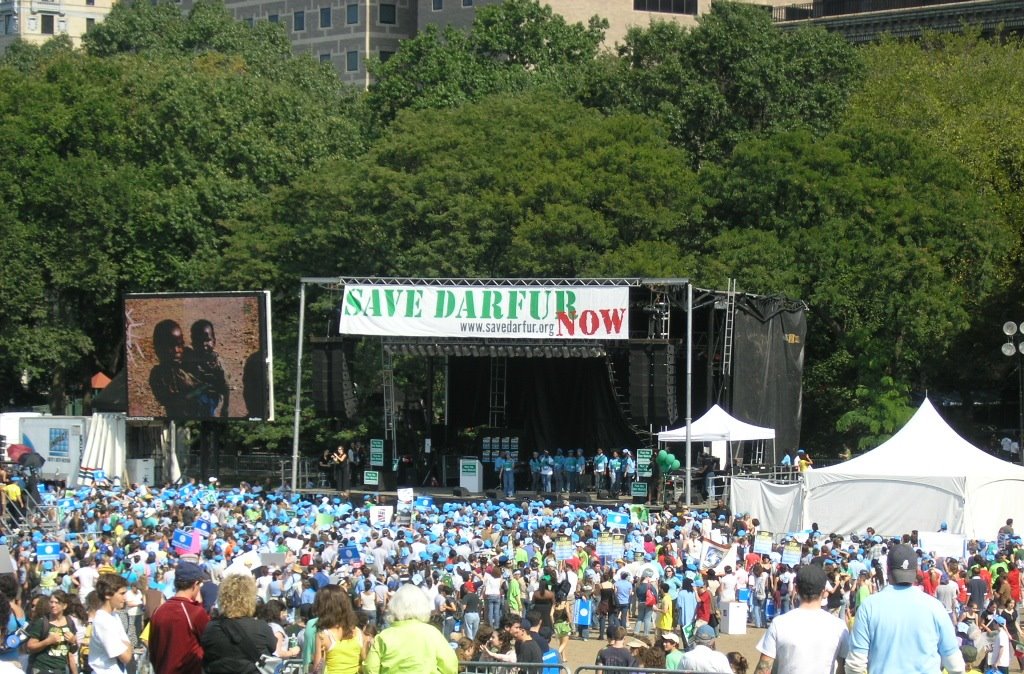
Watch George Clooney's poignant testimony on the urgency of the Darfur situation. Also, this Clooney & Power interview.
Go to SaveDarfur.org to find out how you can help.
Go to SaveDarfur.org to find out how you can help.
Be aware of the world around you. Many of the worst crimes take place because of people's apathy--that's why the government of Sudan & its allies have been killing with impunity.
 A Darfur victim pictured (left). Unless the US, the UN, and the whole international community step in with peace-keeping forces by the end of this month, then, for those who care to watch, we'll witness wholesale murder, again. Read more on the Human Rights Watch site.(photo, hrw.org)
PS. Is this a reflection of our collective priorities? Media coverage of the ongoing genocide in Darfur has been woefully inadequate. The Center for American Progress found that during June 2005, CNN, FOX News, NBC/MSNBC, ABC, and CBS ran 50 times as many stories about Michael Jackson and 12 times as many stories about Tom Cruise as they did about the genocide in Darfur.
September 11, 2006
Some Personal Reflections on 9-11
 On every important date, it’s good to take a few moments to reflect on the meaning of the occasion; and I did just that when I was asked to say a few words to a gathering on the 5thanniversary of 9-11. This is what I said:
 When we bow our heads in a moment of silent prayer or introspection, when we shed a tear for fellow humans beings, when we ask what we could do to save lives, how to comfort the grieving, when we give, when we care, when we feel the pain of a tragic loss, then we are affirming our own humanity! And we are re-affirming that we are capable of greater acts of kindness, altruism, and unconditional love.
I believe that there’s something positive to be learned even from a horrible experience. After all, we are equipped with a wonderful mind that has the ability to create, conceptualize, and guide us by reason. We’re standing here in this educational institution because we have a purpose—to pursue our own dreams, to fulfill our potential, to make a difference! Education is indeed the key to a better world, for it provides us with the tools to better understand ourselves and others! Fanaticism and its consequences come from a narrow mind. We are here in a quest to broaden our horizons. And this is good!
I appreciate the concept, “a culture of life”—a phrase often uttered but not quite understood to mean: making a difference when it matters. In other words, enhancing the human condition & the human experience. I believe we have a fundamental connection to each other, despite our differences and personal preferences, because we all have the same basic potential: to understand and to love.
We feel the loss. We grieve for those who cannot be with us today. But, as long as we are alive, we cannot surrender our humanity to those who act inhumanely, or to those who seek to manipulate & exploit our emotions though fear!
Let’s not forget the sorrow and the reasons behind it. But let us not forget that we have an obligation to ourselves and to humanity. So, asking I must do of you today. I ask you to decipher and disseminate the knowledge you acquire here. I ask you to help build a better world that extends far beyond our borders. I ask you to be engaged and involved citizens. I ask you to be the change you want to see!
Like Martin Luther King said, “Our lives begin to end the day we become silent about things that matter.”
July 06, 2006
The Mugging of the American Dream Continues...
Dumbing Down of America, or, Getting Ahead by Adding More People in the Rear?
We often refer to America as the land of opportunity. Talk to everyone who's made it and he'll tell you that it is so. No surprise there. I don't know if it's easier to make it today than it was in the "good ol' days", but I do know one way to improve your lot is through education. Statistically--you know those numbers that reveal what happens to most people--more Americans are working longer hours, have less job security, are more likely to be uninsured, and they can earn 73% more money over a working lifetime if they have a higher education degree!
As of July 1st, the cost of attending college got more expensive. OK, everything gets more expensive over time, but the question is whether the new pricing system of and the access to higher ed will prevent people from earning a degree. I assume that if the economic pressures on the individual and the family become greater this task would also become harder. Actual family income has fallen. Sure, certain consumer items have become cheaper, but the cost of living as relating to the money people make has been rising faster than their earning power.
Here's a great article that explains a lot more about the burden a student faces in earning a college degree. I assume that most of us would agree that it'd be good to have an educated populate, more competitive and more wealth-producing. Obviously, how we allocate our resources is a matter of national priorities. I often tell my students, it's all about the ..pizza; how we share it, the compromises on the toppings, the size of the slices, and who gets access to the table!
Talking about making a better life for oneself, I found that the best predictor of a person social & economic status is his ..parents! Very few people escape this reality. Of course, if you interview the NBA stars, they could tell you that invariably they came from very poor backgrounds, started learning the game on concrete with a worn out basketball hitting a "basket" with a crooked rim and no net. Millions of young kids in poor neighborhoods are still playing the same game and dream of someday becoming another Michael Jordan. Actually, they believe that they will do so. Unfortunately, way less than 1% ever manage to get a chance to become an NBA player.
 Americans want to give a tax benefit to the heirs of the super-rich
This leads me to the question why so many poor & middle-class Americans consistently vote against their own economic interest. The answer is simple, but not simplistic: they vote their dreams not their economic realities!
As for that "dream," it's worth reading Bill Moyers's speech last year at the Take Back America Conference where he cites numbers, observations, and actual experiences of real people. Here's a short excerpt for you to ponder:
And the outlook is for more of the same. On the eve of George W. Bush's second inauguration The Economist - not exactly a Marxist rag - produced a sobering analysis of what is happening to the old notion that any American can get to the top. With income inequality not seen since the first Gilded Age (and this is The Economist editors speaking, not me) - with "an education system increasingly stratified with fewer resources than those of their richer contemporaries" and great universities "increasingly reinforcing rather than reducing these educational inequalities" - with corporate employees finding it "harder...to start at the bottom and rise up the company hierarchy by dint of hard work and self-improvement" - "with the yawning gap between incomes at the top and bottom" - the editors of The Economist - all friends of business and advocates of capitalism and free markets -- concluded that "The United States risks calcifying into a European-style class-based society."
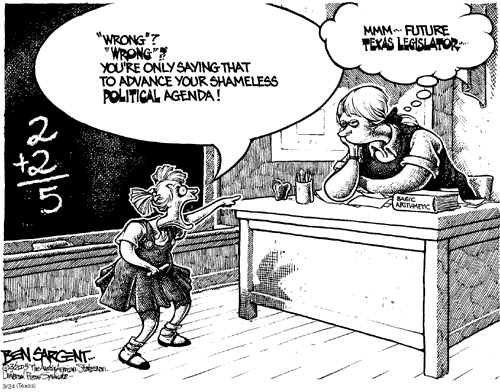
We often refer to America as the land of opportunity. Talk to everyone who's made it and he'll tell you that it is so. No surprise there. I don't know if it's easier to make it today than it was in the "good ol' days", but I do know one way to improve your lot is through education. Statistically--you know those numbers that reveal what happens to most people--more Americans are working longer hours, have less job security, are more likely to be uninsured, and they can earn 73% more money over a working lifetime if they have a higher education degree!
As of July 1st, the cost of attending college got more expensive. OK, everything gets more expensive over time, but the question is whether the new pricing system of and the access to higher ed will prevent people from earning a degree. I assume that if the economic pressures on the individual and the family become greater this task would also become harder. Actual family income has fallen. Sure, certain consumer items have become cheaper, but the cost of living as relating to the money people make has been rising faster than their earning power.
Here's a great article that explains a lot more about the burden a student faces in earning a college degree. I assume that most of us would agree that it'd be good to have an educated populate, more competitive and more wealth-producing. Obviously, how we allocate our resources is a matter of national priorities. I often tell my students, it's all about the ..pizza; how we share it, the compromises on the toppings, the size of the slices, and who gets access to the table!
Talking about making a better life for oneself, I found that the best predictor of a person social & economic status is his ..parents! Very few people escape this reality. Of course, if you interview the NBA stars, they could tell you that invariably they came from very poor backgrounds, started learning the game on concrete with a worn out basketball hitting a "basket" with a crooked rim and no net. Millions of young kids in poor neighborhoods are still playing the same game and dream of someday becoming another Michael Jordan. Actually, they believe that they will do so. Unfortunately, way less than 1% ever manage to get a chance to become an NBA player.
 Americans want to give a tax benefit to the heirs of the super-rich
This leads me to the question why so many poor & middle-class Americans consistently vote against their own economic interest. The answer is simple, but not simplistic: they vote their dreams not their economic realities!
As for that "dream," it's worth reading Bill Moyers's speech last year at the Take Back America Conference where he cites numbers, observations, and actual experiences of real people. Here's a short excerpt for you to ponder:
And the outlook is for more of the same. On the eve of George W. Bush's second inauguration The Economist - not exactly a Marxist rag - produced a sobering analysis of what is happening to the old notion that any American can get to the top. With income inequality not seen since the first Gilded Age (and this is The Economist editors speaking, not me) - with "an education system increasingly stratified with fewer resources than those of their richer contemporaries" and great universities "increasingly reinforcing rather than reducing these educational inequalities" - with corporate employees finding it "harder...to start at the bottom and rise up the company hierarchy by dint of hard work and self-improvement" - "with the yawning gap between incomes at the top and bottom" - the editors of The Economist - all friends of business and advocates of capitalism and free markets -- concluded that "The United States risks calcifying into a European-style class-based society."
Putting higher education out of reach isn't a good thing for most Americans. It isn't a good thing for the long-term health of our country. I'd be the first one to admit that a higher ed degree should not be just a means to a better job, though economic success is a worthwhile goal. But I believe going through college should be an opportunity to further one's horizons, open his eyes to a greater world out there, acquire critical skills and a sharp inquisitive mind. This is progress! We should all be progressives, change things for the better--and, gosh, we need to improve a myriad of things to make a positive difference in the lives of our people. When it really matters, here & now.
PS>Did I make this a political issue by referring to progressive values?
May 04, 2006
Making Noise Versus Being Heard
This past Monday, on May 1st, Mayday, the original Labor Day, immigrants across the country took it to the streets and rallied in protest of legislation that makes being and/or aiding an illegal alien a felony. Rallies were, in general, large, disorganized and peaceful. The rally in Union Square, NY, was reportedly "without incident" according to local news. Having been there, I would agree and I would add that it was a thoroughly hospitable rally. People were not only not fighting, they were smiling. There were dozens of countries of origin represented, several continents and languages to match. However, all seemed to be content to translate for one another as they were able. I heard no obscenities, in either of my two languages. I experienced no pushing or yelling. Attendees seemed calmly pleased.
While many political scientists have suggested that what went on on Monday was illconceived, poorly planned and have warned that it will ultimately be ineffective, I must disagree. First consider the group looking to make noise. They are undocumented immigrants, i.e. according to recent legislation, felons on the loose. These are people who have spent every waking moment of their lives inside the U.S. borders keeping quiet. While they may not have been heard, the simple act of showing their faces and making noise was indescribably empowering. People were smiling with their hearts. They were happy and proud and felt like people, probably for the first time since crossing the border. If we judge the Mayday rallies as a foundation building event instead of a change creating event we may be able to assess them more authentically.
While many political scientists have suggested that what went on on Monday was illconceived, poorly planned and have warned that it will ultimately be ineffective, I must disagree. First consider the group looking to make noise. They are undocumented immigrants, i.e. according to recent legislation, felons on the loose. These are people who have spent every waking moment of their lives inside the U.S. borders keeping quiet. While they may not have been heard, the simple act of showing their faces and making noise was indescribably empowering. People were smiling with their hearts. They were happy and proud and felt like people, probably for the first time since crossing the border. If we judge the Mayday rallies as a foundation building event instead of a change creating event we may be able to assess them more authentically.
April 17, 2006
The American Dream May Become Just That: A Product of Sleep!
As graduation time approaches for many college seniors this year, I wonder how many of them realize the burden the older generations have placed on them. There's lot of talk about education and how beneficial it is, not only for the individual to better his lot, but it's good for the whole nation to have educated citizens. But, access to education isn't easy, because it carries a big price tag; and, it's not getting any better. Not only the US is losing talent to other countries but we are not producing enough engineers and scientists. Fewer people go into the creative arts too, as there's a prevailing cultural attitude that sends young people into fields "where the money is." The conservative bend the country has taken under the current national political leadership is producing a deficit in the three "T"s--Technology, Talent, Tolerance. It is my contention that you need all three "T"s to be a leader and a prosperous country especially in this inter-connected world.
The income gap between the bottom 20% and the top 20% was 30 fold in the 1960s. Today, it's over 70 fold! Obviously there's been a re-distribution of wealth, and since no person operates in the vacuum of space, the national policies implemented in the last 40 years have established certain priorities and have benefits certain groups over others. The argument that rising water lifts all boats might be true, except that in the US the yachts have risen while the rickety boats are sinking. Real wages, or, in other words, the buying power of the mid & lower strata has decreased in the same period. Many Americans have taken a paycut while our economy grew.
What would you say if told that there's a country that has the second highest GDP (behind Luxemburg) but because of its inequality in the distribution of this wealth, this country ranks dead last among all advanced industrialized nations? Not good! Wait, it gets worse! That country is dead last also in fighting poverty! Among the same rich countries, it has the highest percentage of its people that live on half or less the median income. If this isn't a skewed way to divvy up the national wealth, I don't know what is. The working poor and the middle class in our country find it harder and harder to achieve their American dream since the doors of opportunity are fewer today. The commonwealth, the public avenues, the common good are all under attack.

Millions of Americans did achieve their American dream because they could read at the public library when they couldn't afford to buy books. They could go to public schools, and on to higher education, which was public and inexpensive. The GI Bill was a great success--not only in broadening people's horizons through education, but for every federal dollar spend, the economy got $2 back from having an educated and more wealth-producing generation. What happened to this notion of the common good? We've seen a huge surplus turn into a huge deficit in a just few years time, while there are ever increasing cuts in education and in funds that support the commonwealth, that is, all those good things that make a positive difference in the "average person's" life.
The report by the American Political Science Association makes it clear that "increasing inequalities threaten the American ideal of equal citizenship and that progress toward real democracy may have stalled in this country and even reversed." Further, a quarter of all whites in this country have no financial assets, the median white household has 62% more income and twelve times as much wealth as the median black household and that 61% of blacks in this country and half of all Latinos have no financial assets at all!
The illusion that still holds well in this country is that anyone can become anything he/she wants. But, mobility in America has become a myth. Surely, there are exceptions, and we all know of someone who came from very low and rose to heights. But, if we examine the nation as a whole, it's been very hard (impossible to millions of Americans) to climb to economic ladder. Our national leaders speak of an agenda that would further shrink the social services, the scope of the commonwealth, and those mostly affected are the ones with the fewer means. The rich don't need a universal-coverage healthcare system, they don't need libraries, they don't need loans or scholarships to go to college, they don't need the subways & buses to run on time; don't need them at all as a matter of fact.
Yet, our elected leaders who shape our national agenda manage to convince Americans to vote against the latter's own interests! No wonder why the elites want a largerly un- or under-educated public. It's easier to confuse it with a bumper-sticker approach to complicated issues. Sadly, many college graduates are failing the test of citizenship by not being interested & engaged in the political affairs of our country. Politics reflects the people involved in the process, and democracy is as good as the quality of the people. Aristotle characterized politics in the normative sense--as the ultimate duty of a citizen; as the activity in which responsible people ought to be engaged in.
The American dream was about opportunities, about pride in a country as the leader of the free world, about personal & national prosperity, and individual choice and self-fulfillment. Instead our graduates are facing job prospects with lower pay, longer hours, no pensions & health insurance, and a national debt that amounts to $30,000 for every American! [did I hear: bring in the immigrants to share some of this burden] Of course there is hope, but hope for action won't happen by itself. We have to face our problems and deal with them in a responsible way. Dreaming about something we want won't make it so until we decide to wake up and face reality. Otherwise, the American dream will be just that, a dream.
The income gap between the bottom 20% and the top 20% was 30 fold in the 1960s. Today, it's over 70 fold! Obviously there's been a re-distribution of wealth, and since no person operates in the vacuum of space, the national policies implemented in the last 40 years have established certain priorities and have benefits certain groups over others. The argument that rising water lifts all boats might be true, except that in the US the yachts have risen while the rickety boats are sinking. Real wages, or, in other words, the buying power of the mid & lower strata has decreased in the same period. Many Americans have taken a paycut while our economy grew.
What would you say if told that there's a country that has the second highest GDP (behind Luxemburg) but because of its inequality in the distribution of this wealth, this country ranks dead last among all advanced industrialized nations? Not good! Wait, it gets worse! That country is dead last also in fighting poverty! Among the same rich countries, it has the highest percentage of its people that live on half or less the median income. If this isn't a skewed way to divvy up the national wealth, I don't know what is. The working poor and the middle class in our country find it harder and harder to achieve their American dream since the doors of opportunity are fewer today. The commonwealth, the public avenues, the common good are all under attack.

Millions of Americans did achieve their American dream because they could read at the public library when they couldn't afford to buy books. They could go to public schools, and on to higher education, which was public and inexpensive. The GI Bill was a great success--not only in broadening people's horizons through education, but for every federal dollar spend, the economy got $2 back from having an educated and more wealth-producing generation. What happened to this notion of the common good? We've seen a huge surplus turn into a huge deficit in a just few years time, while there are ever increasing cuts in education and in funds that support the commonwealth, that is, all those good things that make a positive difference in the "average person's" life.
The report by the American Political Science Association makes it clear that "increasing inequalities threaten the American ideal of equal citizenship and that progress toward real democracy may have stalled in this country and even reversed." Further, a quarter of all whites in this country have no financial assets, the median white household has 62% more income and twelve times as much wealth as the median black household and that 61% of blacks in this country and half of all Latinos have no financial assets at all!
The illusion that still holds well in this country is that anyone can become anything he/she wants. But, mobility in America has become a myth. Surely, there are exceptions, and we all know of someone who came from very low and rose to heights. But, if we examine the nation as a whole, it's been very hard (impossible to millions of Americans) to climb to economic ladder. Our national leaders speak of an agenda that would further shrink the social services, the scope of the commonwealth, and those mostly affected are the ones with the fewer means. The rich don't need a universal-coverage healthcare system, they don't need libraries, they don't need loans or scholarships to go to college, they don't need the subways & buses to run on time; don't need them at all as a matter of fact.
Yet, our elected leaders who shape our national agenda manage to convince Americans to vote against the latter's own interests! No wonder why the elites want a largerly un- or under-educated public. It's easier to confuse it with a bumper-sticker approach to complicated issues. Sadly, many college graduates are failing the test of citizenship by not being interested & engaged in the political affairs of our country. Politics reflects the people involved in the process, and democracy is as good as the quality of the people. Aristotle characterized politics in the normative sense--as the ultimate duty of a citizen; as the activity in which responsible people ought to be engaged in.
The American dream was about opportunities, about pride in a country as the leader of the free world, about personal & national prosperity, and individual choice and self-fulfillment. Instead our graduates are facing job prospects with lower pay, longer hours, no pensions & health insurance, and a national debt that amounts to $30,000 for every American! [did I hear: bring in the immigrants to share some of this burden] Of course there is hope, but hope for action won't happen by itself. We have to face our problems and deal with them in a responsible way. Dreaming about something we want won't make it so until we decide to wake up and face reality. Otherwise, the American dream will be just that, a dream.
April 12, 2006
A Little Poli Sci Humor
I've seen several versions of the "political science as two-cows", but this one is quite good.
April 06, 2006
The Uneducated Future
How many of our youth must be lost before this nation recognizes that the most important investment in the world is guaranteeing a fulfilling future for the next generation? Education is the most important tool and/or catalyst to reaching life goals. However, believe it or not countless thousands in the United States cannot afford higher education. The lucky ones who can afford to go to school do so baring a much larger burden than their parents once did. An average college student today works two jobs, goes to school full time and relies very heavily on state assistance. The Tuition Assistance Program (TAP) budget has been recently cut and now president Bush is proposing to cut into the most widely used assistance: Federal Loans. About 40 of college students receive the assistance of Stafford and/or Perkins Loans. These loans are extremely valuable because they are provided by the government and have low interest rates. If these loans are cut many will no longer be able to attend College. With the astronomical increase in tuition costs and the continuous cuts in assistance, soon college will be a luxury only afforded to the nations wealthy.
On Monday April 3 Congresswomen Nita Lowey cam e to Pace University to speak to faculty and students about it the importance of investing in this nations youth. The Congresswomen spoke about the many students that would need to incur if it were not for these loans. Lowey also stressed the need for more government action to protect against the reduction and or eradication of federal loan programs. “This is one investment that this country needs to make,” the Congresswomen said and it is quite clearly the truth.
In the end, though it is wonderful to know that some of the nations legislative branch is fighting for our future, we as college students must recognize our importance and find our voice in this struggle for an educated future. Since these legislation impact the youth of this nation the most, it is that same youth that must be heard most loudly.
Know you might be asking: what can I do about this. The answer is that you can do a whole lot. First do a little internet serving about loan cuts or go onto Congresswomen Nita Lowey’s website and see what bills she is fighting against, or lobby for that pertain to education. You should also exercise your right to free speech and contact your local senator. Call them and tell them that you are urging them not to support any legislation that cuts federal loans. Don not be intimidated by calling your local officials, because they really work for you. These officials are elected and you are the one who has power over that so take it. You could also start a petition on campus etc. I think you get my drift that there really is a whole slew of different things you can do. So do not let this nation’s future lose their right, or yours, to a better tomorrow.
On Monday April 3 Congresswomen Nita Lowey cam e to Pace University to speak to faculty and students about it the importance of investing in this nations youth. The Congresswomen spoke about the many students that would need to incur if it were not for these loans. Lowey also stressed the need for more government action to protect against the reduction and or eradication of federal loan programs. “This is one investment that this country needs to make,” the Congresswomen said and it is quite clearly the truth.
In the end, though it is wonderful to know that some of the nations legislative branch is fighting for our future, we as college students must recognize our importance and find our voice in this struggle for an educated future. Since these legislation impact the youth of this nation the most, it is that same youth that must be heard most loudly.
Know you might be asking: what can I do about this. The answer is that you can do a whole lot. First do a little internet serving about loan cuts or go onto Congresswomen Nita Lowey’s website and see what bills she is fighting against, or lobby for that pertain to education. You should also exercise your right to free speech and contact your local senator. Call them and tell them that you are urging them not to support any legislation that cuts federal loans. Don not be intimidated by calling your local officials, because they really work for you. These officials are elected and you are the one who has power over that so take it. You could also start a petition on campus etc. I think you get my drift that there really is a whole slew of different things you can do. So do not let this nation’s future lose their right, or yours, to a better tomorrow.
April 03, 2006
Motherhood and Apple Pie Still Popular in the US
The other day I attended a Congressional luncheon by the Westchester Community Affairs (WCA). The best part of the affair was the food. The three House members present made a few remarks about the Indian Point nuclear plant, immigration, healthcare, and how hard everybody works to bring good things to life. Obviously this wasn't a symposium whereas a good debate would take place, nor it was the place to acquire knowledge. The elected officials didn't really make news, nor did they fall outside their wide platitudes of all things to all people.
On Indian Point all agreed that there have been serious violations and safety concerns. The agencies charged with supervising our nuclear plants are dominated by industry insiders and have the efficiency of heck-of-a-job Brownie's FEMA. So, the 20 million people within 50 miles of this plant still face a grave threat. I suppose that the nuclear plants are here to stay as the President's vision of the future (in addition to a Rapturist view) reveals.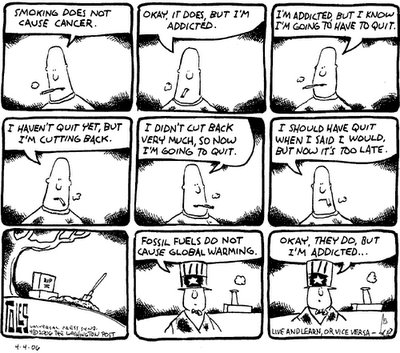 On healthcare, the most pointed remarks against the failed system and the few who make multi-million dollar bonuses for keeping the rest of us holding the screw came from the WCA's director C. Mooney. The responses from those in-the-know were targeted at blaming the "wrong-doers" but not much in terms of fixing a healthcare system that costs so much and leaves so many Americans unprotected. There were some ideas for yet a few more patches in a worn & small-sized quilt that leaves too many of us exposed. No one wants to talk about a single-payer, universal health care system. We spend 17% of GNP on healthcare, more than any other country. Canada and Switzerland come in second place as the big spenders with 12% and with universal coverage. I wonder how many more Americans are at risk from an inadequate health care system than they are from the deadliest terrorists...
Speaking of terrorists, all are for a secure border, whatever it takes. Never mind that the terrorists didn't need to climb a fence, dig a tunnel, cross a desert, to get in here and do their work on 9-11. We couldn't wisely use our laws and tools at our disposal to prevent the attacks, so instead of being smarter we built a bigger bureaucracy, named it in Orwellian fashion, The Dept. of Homeland Security, and passed draconian laws to make us less free. Immigration poses a threat to our way of life, our economy, our culture, they tell us. Most of the arguments today aren't new at all. They've been re-circulating every so often since the 1800s! A bad law doesn't address reality, and if we get a bad law today it'll stay on the books for a very long time. Maybe DeLay's disgraceful departure from the House will open the door for some fresh air this November.
Like millions of Americans who break the law by buying prescription drugs from Canada, the undocumented immigrants skirt a bad immigration law that's even worse in its application & enforcement. In the din of the forks & knives hitting the china, there was agreement in the room against giving amnesty "to those who broke the law." Though, I think I heard some murmur from the waiting staff, and then I thought that those remarks should have been delivered after all the food and drinks had been served. Having a full stomach, I wanted to ask those upper class people why they've already given amnesty to themselves and to all American businesses that have benefited from this hard-working and underpaid labor pool....
Anyway, I can say that there were many well-intentioned people present and it was nice meeting some of them. I hope I'm invited to the next WCA's Congressional luncheon, because I don't often get to have such a scrumptious food for lunch. And, you know, working in the academia makes one very hungry.
On Indian Point all agreed that there have been serious violations and safety concerns. The agencies charged with supervising our nuclear plants are dominated by industry insiders and have the efficiency of heck-of-a-job Brownie's FEMA. So, the 20 million people within 50 miles of this plant still face a grave threat. I suppose that the nuclear plants are here to stay as the President's vision of the future (in addition to a Rapturist view) reveals.
 On healthcare, the most pointed remarks against the failed system and the few who make multi-million dollar bonuses for keeping the rest of us holding the screw came from the WCA's director C. Mooney. The responses from those in-the-know were targeted at blaming the "wrong-doers" but not much in terms of fixing a healthcare system that costs so much and leaves so many Americans unprotected. There were some ideas for yet a few more patches in a worn & small-sized quilt that leaves too many of us exposed. No one wants to talk about a single-payer, universal health care system. We spend 17% of GNP on healthcare, more than any other country. Canada and Switzerland come in second place as the big spenders with 12% and with universal coverage. I wonder how many more Americans are at risk from an inadequate health care system than they are from the deadliest terrorists...
Speaking of terrorists, all are for a secure border, whatever it takes. Never mind that the terrorists didn't need to climb a fence, dig a tunnel, cross a desert, to get in here and do their work on 9-11. We couldn't wisely use our laws and tools at our disposal to prevent the attacks, so instead of being smarter we built a bigger bureaucracy, named it in Orwellian fashion, The Dept. of Homeland Security, and passed draconian laws to make us less free. Immigration poses a threat to our way of life, our economy, our culture, they tell us. Most of the arguments today aren't new at all. They've been re-circulating every so often since the 1800s! A bad law doesn't address reality, and if we get a bad law today it'll stay on the books for a very long time. Maybe DeLay's disgraceful departure from the House will open the door for some fresh air this November.
Like millions of Americans who break the law by buying prescription drugs from Canada, the undocumented immigrants skirt a bad immigration law that's even worse in its application & enforcement. In the din of the forks & knives hitting the china, there was agreement in the room against giving amnesty "to those who broke the law." Though, I think I heard some murmur from the waiting staff, and then I thought that those remarks should have been delivered after all the food and drinks had been served. Having a full stomach, I wanted to ask those upper class people why they've already given amnesty to themselves and to all American businesses that have benefited from this hard-working and underpaid labor pool....
Anyway, I can say that there were many well-intentioned people present and it was nice meeting some of them. I hope I'm invited to the next WCA's Congressional luncheon, because I don't often get to have such a scrumptious food for lunch. And, you know, working in the academia makes one very hungry.
Subscribe to:
Posts (Atom)